
Despite centuries of commentary and study, the route of the Exodus has come to be associated with a hodgepodge of conflicting theories. Even the true whereabouts of Mount Sinai, an object of great historical curiosity, is in doubt. Likewise, the nature and location of the Sea of the Exodus, commonly called the “Red Sea” or the “Reed Sea,” is steeped in uncertainty and contradiction. Kadesh-barnea, the place from which the Hebrews sent spies into Canaan, seems to have evaporated from human memory. These geographical conundrums have caused some modern critics to dismiss the reality of the Exodus and the historicity of the biblical record.
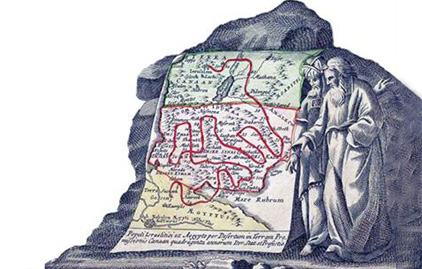
The enigmatic route of the Exodus!
The difficulty of delineating the Exodus route began with the event itself, which took place in a territory that remained largely uncharted until the 19th century AD. In all likelihood, the chronicle of Moses was viewed by the ancient Hebrews as a sufficient record of the journey. Although a multitude witnessed the event, the lack of accurate maps and known landmarks precluded the transmission of its geographical details to succeeding generations.
The understanding of the Exodus has also been complicated by the popular Mount Sinai and Red Sea traditions, which developed long after the event, at a time when the geographical knowledge of the region was crude and incomplete. Nonetheless, many modern commentators have tended to accept the basic premise of the traditions, and place the “Sea of the Exodus” near Egypt and Mount Sinai within the Sinai Peninsula.
Although the Exodus route is primarily a geographical problem, it has lacked rigorous geographical research. Investigators have, instead, relied on the non-geographical methodologies of Egyptology, linguistics, textural criticism, and archaeology. However, such methodologies cannot be meaningfully applied until a reliable geographical framework has been established. The ultimate source for that framework is Moses’ eyewitness record in the Bible, which is the only ancient account of the event.
This early 19th-century map shows a traditional Exodus route crossing the Gulf of Suez near Egypt and much of the itinerary within the Sinai Peninsula. To this point, there is no evidence for this concentration of ancient activity within the Peninsula.
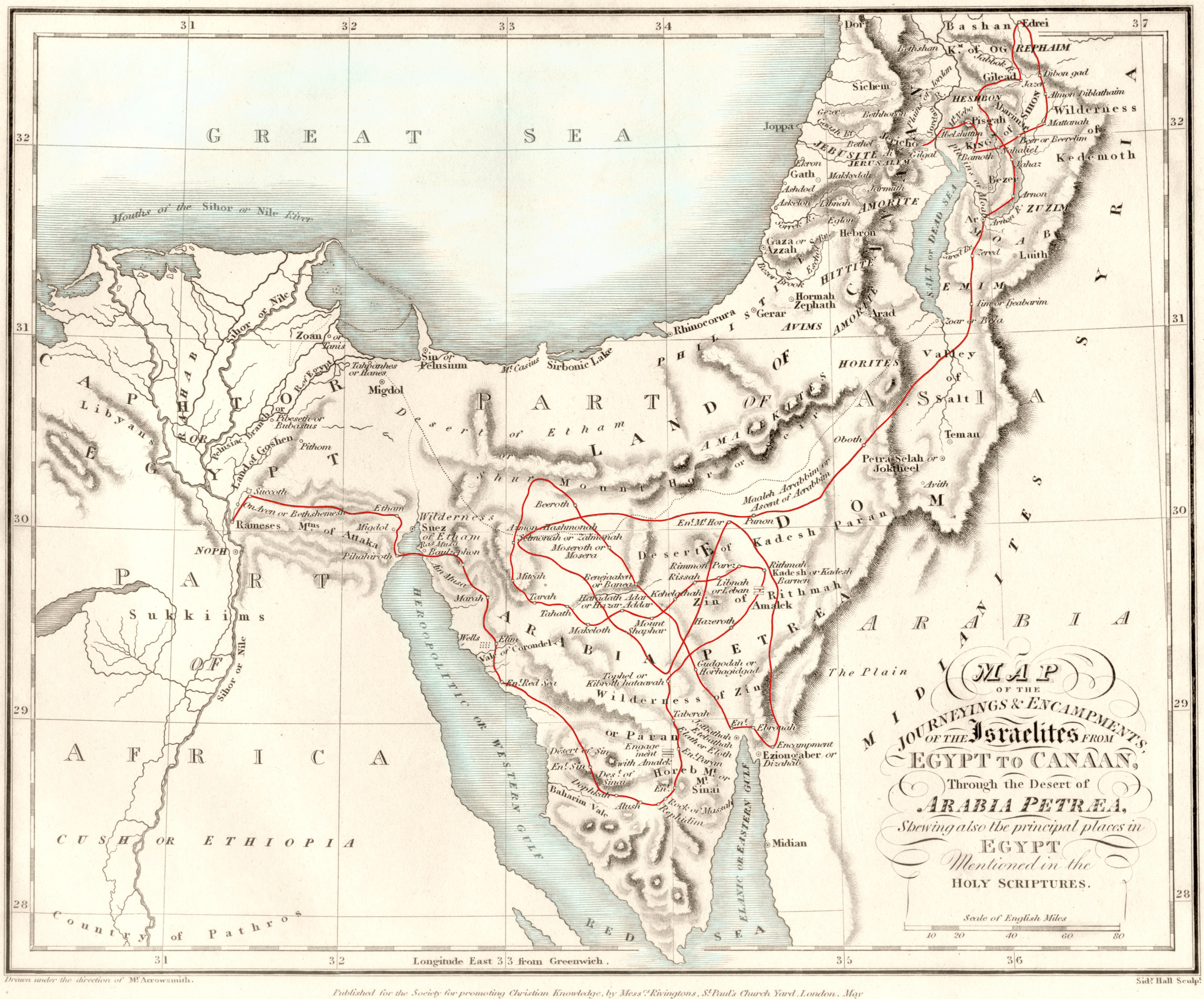
Early 19th-century map showing a traditional Exodus route.